On Distinctions and the Here-and-Now
This piece explores two premises and what they mean for my own practice. I am not against frameworks and thinking in systems, but I subordinate them to what unfolds in the here-and-now. I take selection as inevitable in how we relate to the world, and that supports a more critical view of practice.
- There is no uncontained view of the world. Everything said is said by someone*. There is text, context, and the distinctions that were made in selecting those.
- The present in social relations only shows up in the local process of relating in the here-and-now.
Taken together, these two premises set up a practical question: how should one work when both distinction and relation are unavoidable?
On the inevitability of making distinctions
Making distinctions does not mean we can clearly separate parts and wholes, different domains, or even binaries such as local/global and outside-in/inside-out. They are all used to allow us to communicate and make sense of things. Regardless of the choice, it is the fact that we are choosing what matters here.
To acknowledge that an intervention in the world requires a type of distinction (a separation that is fundamentally created) is a recognition of that tenet. Every use of distinction involves choice, and that choice is permeated by social, historical, and political rather than naturalistic or being observer-independent.
As I explored here, being observant-dependent does not mean relativism. Sometimes people within a specific context agree on distinctions, and those agreements—though made up—can function as the source of truth in that context. We make agreements about institutions, money, laws, and costumes, as well as about how to behave in groups and organisations. Those agreements are created, re-created, and challenged in daily interactions, and they constrain and enable our actions much like biology and the natural world do.
So distinctions are always in play, which raises the questions: who makes them, how aware are we of them, and how are they sustained?
It also brings up the question of how much those distinctions and the decisions based on them can be defined by power, structure, etc, and how much of that dynamic in itself is a conscious selection.
In our role as facilitators, consultants, or hosts, we can pay attention to the distinctions we and others are making, and invite others to do the same. We cannot be aware of all of them, let alone all the time. Rather than ranking selections a priori, the work is to recognise the selections in play and engage them critically.
We can examine the language of choice and how it mirrors those distinctions. We can inquire into the past and present decisions behind them, conscious or unconscious, coherent or not, and what direction they may be pointing in.
Our role is one among many, and we practice both in relationship and over time. We enter a process already in motion, usually with a task at hand, but immersed in the complex relational process like everybody else. We can carry tools and experiences, but the work is to subordinate them to the experience of relating and the contracted task, not the other way around.
One powerful critique on intervention lies with the practitioner who arrives creating their own boundaries, either bringing a structure or their assumptions. On one hand, we recognise this is unavoidable, whether consciously or unconsciously. But on the other hand, the work is to inquire into how this is happening and how it serves the process we are engaged in. For that, we can work with others, through supervision, and in reflective and reflexive spaces.
On systems, frameworks, and relating in the here-and-now
All systems, frameworks, theoretical paradoxes are taken as selections and therefore created by someone within their own context. It can be a framework created by a management consultancy, our institutions (the law, education, etc), or a colonialist narrative passed down generations. They do not all hold the same declarative power, of course, but as declarations, it is not enough to set them up, we have to critically re-evaluate them: remember the text but also the context and who has been declaring it, and then check its validity, scope, usefulness.
Our declarations and actions in turn constrain and enable later decisions and possibilities. This entangled dance contributes to a process of relating with the world that is predictably unpredictable*.
If we accept the inevitability of distinctions and selection, we are coping with irreducible complexity by accepting that we depend on a picture to operate, and every picture comes with borders. So we can talk about an imagined unbounded world, but only from within boundaries. It’s bounded unboundedness.
It’s then pointless to be against systems, frameworks, or any other bounded view or selection, provided we acknowledge their inherent limitations.
We make use of predictions knowing the social world is unpredictable, and talk about ‘global’ knowing we cannot fully see or claim to completely understand it.
That said, the most important part of our work is not juggling pre-bounded selections. Importing abstract concepts or asking people to fit their experiences into a pre-defined grid it’s a great way to contain anxiety and may even generate novel explorations, but what we experience together, the re-emergence of relating as relation happens, is what paints the picture of the collective and it is the closest to ‘what is’ that we can get.
This is not because the local and here-and-now is better than the global and there-and-then. But the present in social relations only shows up in the local process of relating in the here-and-now. Everything else is past and future. Claiming this local relation is a fractal of the global is intuitive, even likely, but unnecessary. In the social realm we can expect, but cannot know what will unfold in the present and how that might impact beyond the local.
Taken together, we recognise the centrality of the process of relating without the need to assume any global outcome. We also acknowledge the inevitability of selection, so we need not pretend otherwise while reflecting on its choices and effects.
Reflecting
The inevitability of distinction, and the need for some level of abstraction in communication, means we act based on premises and argue from assumptions we rarely name. Our argument here, which resists privileging frameworks over lived experience, is itself an example of that: grounded in experience, it is still articulated as a conceptual frame.
In the same way, we do not want to trivialise “global” understanding, even as we rely on concepts that point to non-local phenomena such as colonial narratives. The point is not to reject abstraction, but to remain attentive to how it is made, by whom, and to what ends.
*“Everything said is said by someone” was said by Humberto Maturana.
*“Predictably unpredictable” is Ralph Stacey’s.
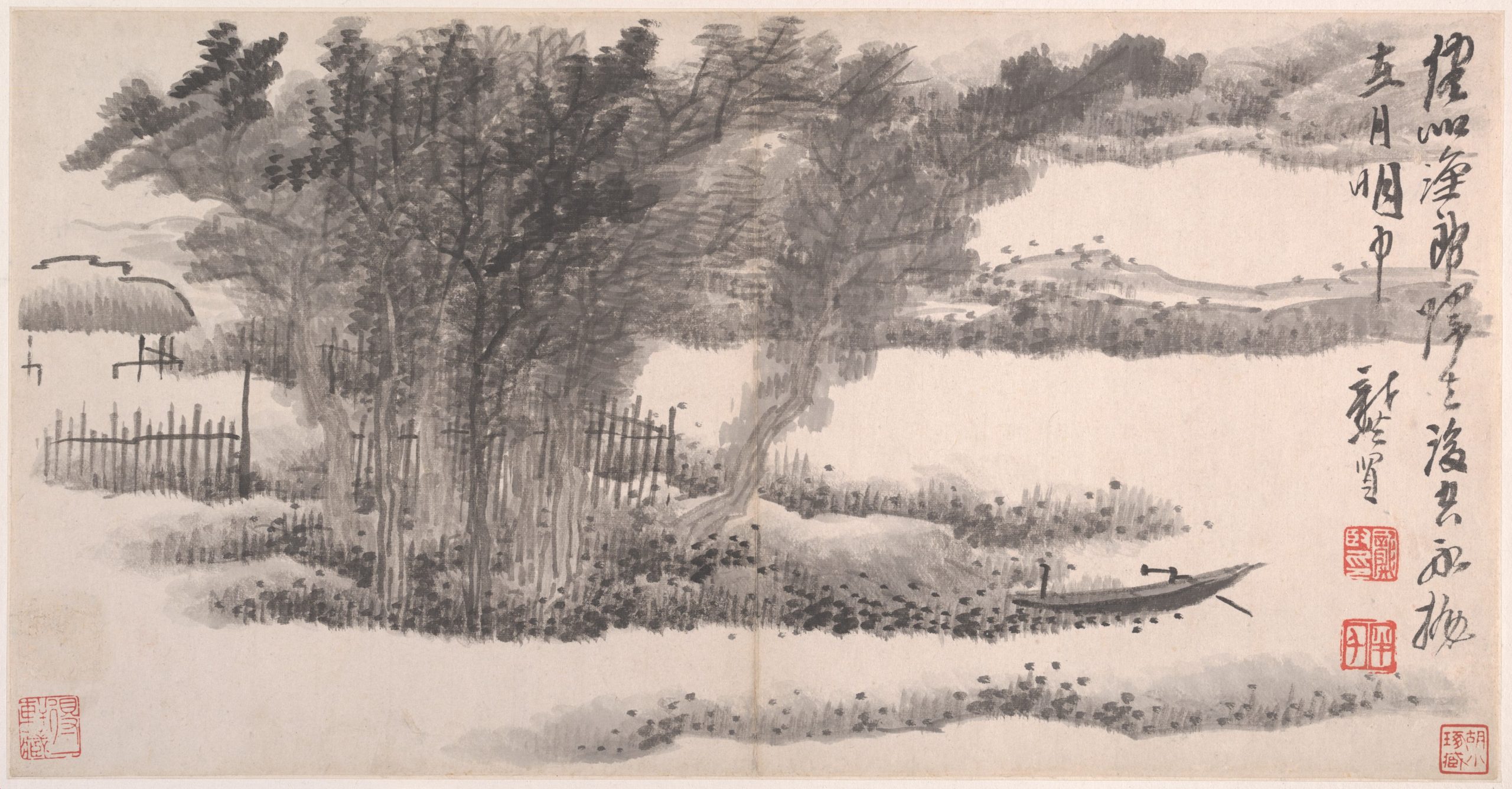
*The picture is a landscape by Gong Xian.