Language vs. Reality: Landmarks We Coordinate Around
I read Language vs. Reality: Why Language Is Good for Lawyers and Bad for Scientists — N. J. Enfield
One of our greatest accomplishments as a species was the use of language to coordinate around reality. Even with the limitations on accessing reality directly, we progress into making better sense of it while also constraining its unbounded complexity in order to coordinate around it.
The book’s name plays with those two: the difficulties of the use of language to depict reality in the clear terms scientists would aspire to, and the language games we use to make sense of the world in general - and the social one in particular - and coordinate action and understanding.
“Language is not good for capturing and transmitting the details of reality. What it’s good for is providing landmarks we can coordinate around.”
I’ve explored similar places in How Language Shapes… talking about Maturana and in Observant-Dependant Social World, about humans depicting reality as the observers they are.
Enfield starts exploring experiments on how people describe, coordinate, and eventually label and start referring to abstractions as a support system for more efficient coordination. In one experiment, one person is looking at tangram figures laid out in a different order than another. One person describes the figure and the other identifies the matching one. He explores the tendency to simplify and use minimalist language when possible. One description that started with “All right, the next one looks like a person who’s ice skating, except they’re sticking two arms out in front”… to eventually simply “The ice skater”.
In his own research, he and his colleagues touch on an interesting topic of natural constraints and description. They showed an unlabelled image of the body and asked participants from different language backgrounds to provide their own. English speakers would differentiate the arm and the hand by a natural discontinuity (the wrist), but other languages do not work the same way. Some will bundle the upper and lower arm plus the hands into one single word!
| Language | Upper Arm | Lower Arm | Hand | Upper Leg | Lower Leg | Foot |
|---|---|---|---|---|---|---|
| Jahai | bliŋ | prbɛr | cyas | blɨʔ | gor | can |
| Punjabi | baa | baa | hatth | lətt | lətt | pœr |
| Dutch | arm | arm | hand | been | been | voet |
| Japanese | ude | ude | te | ashi | ashi | ashi |
| Yélî Dnye | kêê | kêê | kêê | kpââli | yi | yi |
| Indonesian | tangan | tangan | tangan | kaki | kaki | kaki |
| Savosavo | kakau | kakau | kakau | nato | nato | nato |
| Lavukaleve | tau | tau | tau | tau | tau | fe (tau) |
Table from the book, page 45
These different distinctions show that our descriptions are not completely constrained by the natural discontinuities of our physical bodies (in this case, wrists and knees). But his other examples show a more interesting nuance: although descriptions vary, they tend to align and respect the predictable natural boundaries, in this case, the perception of prominent joints. So distinctions are constrained by the physical world, yet they do not dictate description.
“first, reality is reduced by perception; then, perception is reduced by language.”
I explored a related dynamic in Reality Bias, looking at how our need to compress complexity into neat explanations helps us act, even as it narrows what we notice.
The second part of the book is called “Nudged by Language” and explores how those reductions can be both misleading and designed to be so. He explores classic experiments on language interference (when they ask you to say the text color but ignore what’s written) or semantic priming - a way to divert attention to prime one description over others.
“When you put things into words, you are creating landmarks in the map of reality as pointers you want to coordinate around. (…) Framing is where the partial and constrained nature of language’s relationship with reality becomes weaponized.”
He also talks about framing, and how it is often a battle for power.
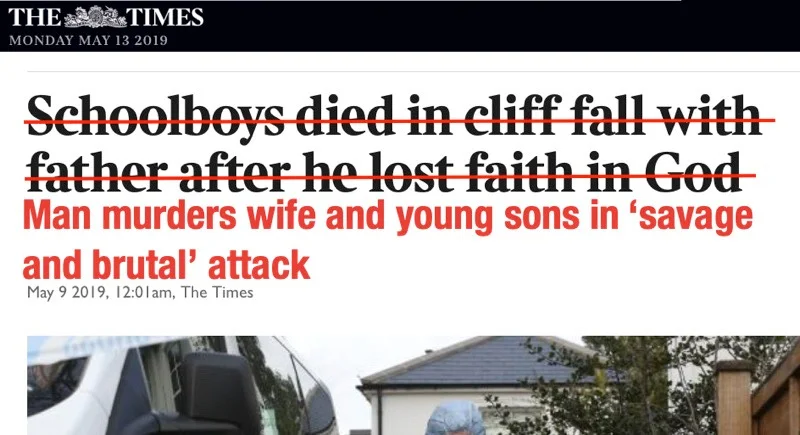
From the book, page 137 — via Jane Gilmore’s FixedIt
Then he moves from words to stories, their function in social bonding, and how they help us make sense of the world that we share. In how we work on the process of making sense together, he brings back the power of defining shared points of reference among the members of a community.
“the things we say - whether or not they convey true information - are attempts to publicly establish those points of reference. (…) whatever your reasons, simply by using some words and not others, you are always making a claim to set the agenda for what we should coordinate around.”
That ties up with a reflection on borrowing other people’s distinctions, especially if they come in wrapped and neat form, and when they are stripped from the history and intention of the one declaring it, disguising the claim, the judgement, the choice—a theme I unpacked further in There Is No Standing Outside, Ever, Not Even Once.
The book is a great exploration of language and the warning is clear: language is in itself a seductive, clear system that helps us cut corners, but is also dangerous when one can set the terms for social coordination without scrutiny. The author asks:
“Why this map and why those landmarks? What are this person’s reasons for saying that, and for saying it like that? How else could it have been said? In the mercurial cartography of language, we need to remember there is a real terrain beyond the maps.”
In organizational life, we constantly coordinate around inherited maps—buzzwords, strategic frameworks, and problem labels treated as objective terrain rather than human choices (something I touched on in We Have Answers to Questions We Never Asked). Part of the work of hosting reflective spaces is slowing down that automatic coordination: surfacing the unspoken history behind a group’s favorite words, asking what those distinctions leave out, and inviting people to redraw the map together.
Language vs. Reality: Why Language Is Good for Lawyers and Bad for Scientists — N. J. Enfield (The MIT Press, 2022)

Written by Augusto Cuginotti
Organisational change, Narrative inquiry & Facilitation
Subscribe to the newsletter
New essays, narrative inquiry notes, and reflections on culture and change, sent occasionally.